
FWD Live! Understanding and adapting to members’ and customers’ needs
FWD Live! brought together industry executives for a forward-looking discussion on wholesale. The aim of the event was to combine big-picture thinking with practical action.
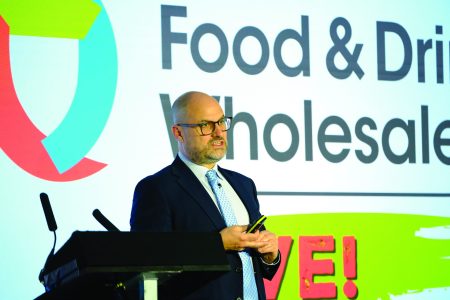
James Bielby: ‘Wholesale is doing an amazing job in creating jobs for the future.’
From promoting wholesale as a career choice to shaping new legislation, Food & Drink Wholesale UK (widely known as FWD) is supporting its members to grow and develop.
At the same time, wholesalers continue to grasp business opportunities by adapting to shifting consumer behaviour. These were some of the issues highlighted by speakers at the FWD Live! conference, held earlier this month in Stratford-upon-Avon.
FWD chief executive James Bielby gave delegates some examples of the work the organisation is doing to strengthen the wholesale industry.
A ‘Women Leading Wholesale’ network was launched in January in response to research that showed there is a lack of visible female role models.
“We want to ensure that we are giving opportunities to showcase female leaders driving the channel forward and supporting the development of people coming through. It’s a really exciting programme,” commented Bielby.
Next month, the FWD is going to be promoting wholesale as a career to Parliament. “We’re going to be saying that wholesale is doing an amazing job in creating jobs for the future,” he said.
Other events coming up include an alcohol category event. This follows an event that focused on tobacco and vapes and led to a new forum being set up to tackle the illicit trade.
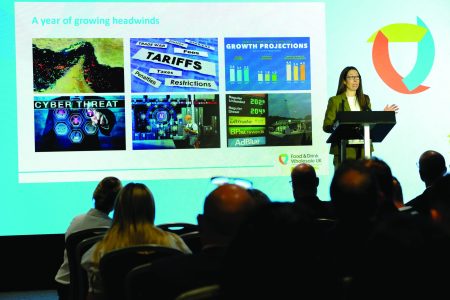
Katherine Morgan: ‘We’re telling the Government what you need to happen.’
DGA supports the FWD with political and policy advice, and one of its managing partners, Katherine Morgan, told delegates that the firm not only aims to defend and protect FWD members’ businesses from political and regulatory threats, it also shapes policy: “We’re not just sitting back – we’re telling the Government what you need to happen and what they need to do to enable you to operate in a better environment.”
Issues that DGA is currently focusing on include potential increases in corporation tax and the National Living Wage, as well as employment rights. “We are talking a great deal to government about policies around employment and responding to many consultations. And of course, EPR, DRS and big sustain-ability measures are coming in that we need to address.”
Morgan urged wholesalers to get involved with DGA’s work for the FWD. “In order for us to do our work really effectively, we need your help,” she said. “Help us to respond to consultations and please give us your data. We need to have evidence to make our case to government.”
She added: “We really appreciate it when people host MP visits. So if you can have an MP or a political representative at your business, it’s incredibly helpful for us because it enables people to understand the sector and the work that you do.”
In the same way that MPs need to understand the wholesale industry, wholesalers need to understand consumers. At FWD Live! a panel of senior wholesale executives considered the sales opportunities created by changing consumer habits.
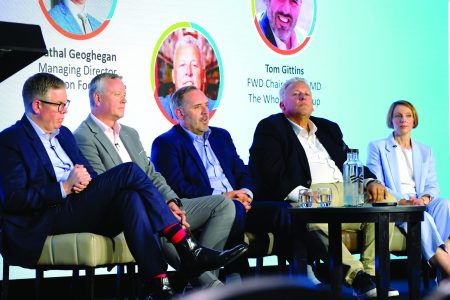
Panel members (left to right): Charles Abraham of Bestway Wholesale, Cathal Geoghegan of Henderson Foodservice, Tom Gittins of The Wholesale Group, Noel Robinson of Parfetts, and Sarah Guest of Rowan International.
Tom Gittins, managing director for retail at The Wholesale Group, said: “If you look back 20 years, we didn’t know what energy was – that wasn’t a category – and since then there have been various upgrades and different things coming onto the market.
“We heard earlier from retailers that they’re looking more and more for new products, experiential reasons to come to a convenience store, and it’s the same in foodservice as well, whether at a coffee shop when you put matcha in a coffee, or whatever it may be.
“I think that younger people especially are looking for new products, looking for new experiences, and that will only ramp up as the younger generation get older.”
Cathal Geoghegan, managing director of Henderson Foodservice, said: “We always have to adapt – resilience is all about adaptability and embracing change.
“The consumer is looking for a lot more experimental experience, not spending maybe as much, but wanting a value-added piece. Therefore we have to assist our customers by bringing new products to the table that help them grow and in turn will help us grow.”
Charles Abraham, foodservice director of Bestway Wholesale, said: “I think the change in consumer habits affects both sides – retail wholesale and foodservice wholesale – but the foodservice market is fundamentally different.
“The demand for innovation is there; I spent three years leading the food strategy for Sodexo, and innovation – looking to the supply chain for that to be developed – is a key part of what we did. I think there’s a huge opportunity within wholesale to get ahead of innovation more than it does today and create value for customers.”
Noel Robinson, joint managing director of Parfetts, said: “There’s a lot of retailers out there who are entrepren-eurs, and they’ve got visions of where they want to take their store. And what they want is for wholesalers to work hand in hand with them: development plans, arranging the space to take account of the growth opportunities, the right sites, the right investment in the store.
“That all leads to growth, so the supplier wins, the wholesaler wins, and the retailer wins.
“Then there’s supplier engagement. For us it’s about partnership and collaboration, and when we agree something we actually do our best to deliver it.
“So between the retailer professionalising, and us working closely with the suppliers, that’s the opportunity.”
Sarah Guest, managing director of Rowan International, which specialises in excess stock, addressed the issue of the risk for suppliers in bringing new products to the market and for wholesalers in being left with unsold stock.
“One of the things for a business like ours, and where we try and work with suppliers, is providing an alternative outlook before it becomes a problem,” she said.
“NPD is always required because consumers want choice and variety, and then they’ll go back to the original flavour and favourites that they loved. But if we work with teams at the point at which they’re innovating and think about different routes that are within the wholesale or discount channel across different countries, then actually there are different routes out.
“That means you don’t end up with the problem of having to think, ’What am I’m going do and how much money is this going to cost me?’ – and that’s where businesses like ours really come to the fore.”
Published Date: June 17, 2026